


Total Visitors
- 5,611,912
Search Inside
My You Tube Channel
-
Visitors on The Site

-
Join 6,676 other subscribers
Fill This Form to Contact Me
Top Posts & Pages
- Waste to Energy in India
- About Me and This Site
- Physical Divisions of North America: An Overview
- Levant: The Term, The Region and Cities
- Silt: Environmental Impact
- The Structure of the Ocean Floor(Ocean Topography)
- Migration Theories : Lee’s Push Pull Theory
- Gond Tribe of India
- Discontinuities Inside the Earth
- Santhal:Largest Tribal Community in India
Being Social
Pages
- Article Submission
- Basics of Geography
- Book Reviews
- Disaster Management
- Field Training and Tour
- Geography Notes
- Geography of Tourism
- Geography Study Material for NTA-NET & IAS Exams
- Geomorphology
- Geomorphology Class Black Board
- Hindi Posts
- Human Geography
- My Projects
- New UGC NET Syllabus-Geography
- Online Class
- Posts on Geography Practicals and Statistical Techniques
- Regional Studies
- Settlement Geography
- Social Geography
- Urban Agro Systems
- Urban Systems
- Useful Links
- Water Resources
- About Me and This Site
Blogroll
Digital Blackboards
My Pages
Other Sites I Am Involved With
Recommended Links
Useful Links
Geographical Facts about Great Britain
Guest Post by Afzal Zaheer
Great Britain is regarded to be the largest island in Europe. The place has various interesting as well as mind-blowing facts which you would have never heard before.
Great Britain is the ninth largest island in the world. It houses United Kingdom which includes England, Scotland, Northern Ireland, as well as Wales. Spread on a total area of 88,745 square miles, it has a total population of 62.64 million (2011 estimate). The place offers historical and natural beauty as it boasts about a global city namely London along with various other comparably smaller cities in the form of Scotland, Edinburgh
How “Great Britain” got its name?
The name “Britain” was used since ages, yet the term “Great Britain” was officially practiced since 1474 after the marriage proposal between Edward IV of England’s daughter, Cecily, and James IV of Scotland got underway. Today, “Great Britain” comprises of three countries in the form of England, Scotland as well as Wales.
Early Habitation
Great Britain was inhabited by early human since 500,000 years. There was a land bridge at the earlier times which became the entry path for humans to come from continental Europe. Archeological proof has categorically unearthed an interesting fact that humans used to go to continental Europe through land bridge which later on was closed to give it a shape of an island.
If you thought that the island will have large amount of fauna due to its massive size, then you need to think again. Since, rapid industrialization has caused great destruction. Therefore, you can only be a witness to few mammals, mice etc and they constitute roughly 40%. However, you can easily appreciate great variety of trees as well as wildflowers as there are whopping 1,500 species of them.
The region is mostly an industrial sector with small amount of agriculture. There are various agricultural products which are grown in the region and prominent among them are cereals, potatoes, oilseed, vegetables cattle etc.
Climate
Great Britain usually has cool climate and it turns out to be cloudy during winders. The western part is greatly influenced by ocean; therefore, it is mostly windy and rainy. The eastern part is mainly a dry region with is comparably less windy. The temperature in London usually remains at 2.4˚C in the month of January while it goes up to 23˚C in July.
Invasions
History has been the proof that Great Britain was invaded several times. In 55 B.C.E the Romans invaded the place and spread their Empire. Various tribes also invaded the region. Since 1066 the region was increasingly ruled by various kings and queen due to Norman Conquest, which ensured the cultural as well as political development of the region.
Finally, aforesaid are the geographical facts about Great Britain which will surely surprise you to the core.
Author Bio:Afzal Zaheer is the owner of Socialnerves.com where he is providing useful information for small business entrepreneurs and social media. Being a content writer as well, he has the credit of writing for various esteemed sites too.
Posted in Guest Post
1 Comment
Living with livestock, and livestock livings, in the city
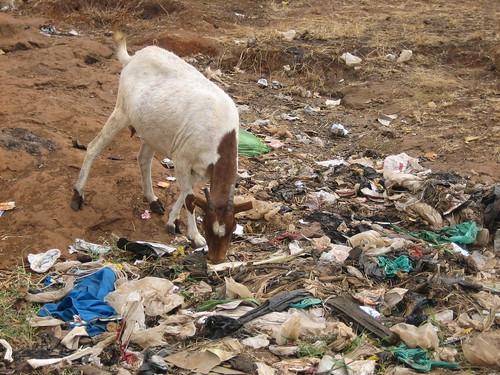
Goat in Nairobi slum (photo on Flickr by The Advocacy Project).
‘. . . [L]et’s consider what it means to raise urban livestock in the developing world, where people are poorer and hungrier, and cities are much more densely populated. It’s a starkly different picture of people and animals living together, and the question of how it’s done has major implications for improving food security and preventing public health disasters.
‘While humans have been raising food animals in their homes for thousands of years, what’s different now is that they’re doing it with so many other humans crammed next to them.
And they’re not just feeding their families: They’re feeding their neighbors, too. Worldwide, 34 percent of meat and nearly 70 percent of eggs are produced in urban areas, according to a 2008 report by the World Bank and the Food and Agriculture Organization. In Maputo, Mozambique, for example, a…
View original post 424 more words
Posted in Uncategorized
Leave a comment
Black Hole Powered Jets Plow Into Galaxy
This composite image of a galaxy illustrates how the intense gravity of a supermassive black hole can be tapped to generate immense power. The image contains X-ray data from NASA’s Chandra X-ray Observatory (blue), optical light obtained with the Hubble Space Telescope (gold) and radio waves from the NSF’s Very Large Array (pink).
This multi-wavelength view shows 4C+29.30, a galaxy located some 850 million light years from Earth. The radio emission comes from two jets of particles that are speeding at millions of miles per hour away from a supermassive black hole at the center of the galaxy. The estimated mass of the black hole is about 100 million times the mass of our Sun. The ends of the jets show larger areas of radio emission located outside the galaxy.
Full Story and Images: http://www.chandra.harvard.edu/photo/2013/4c2930/
Posted in Uncategorized
Leave a comment


