Is a secret a lie?

Jeremy's avatarOpen Geography

Is a secret a lie? That is, in and of itself, are secrets lies?

This thought was engendered by the events of the last week about previously classified court orders and data mining programs at the NSA, and the larger world of classified activities.

In “history of the lie” Derrida states that a lie is not an error. You can be in error about something, mistaken about it (“why did you miss the meeting at 1pm?”, “oh I thought we were meeting at 2pm“) without lying. As he also says, one does not lie simply by saying something that is false, as long as “one believes in good faith in the truth of what one believes” (p. 31).

Instead, “to lie is to want to deceive the other, sometimes even by saying what is true” (31). Is that what a secret does? A secret withholds, it withholds the…

View original post 369 more words

Posted in Uncategorized | Leave a comment

Phallocentric Space: Any Contest Over Power is a Contest Over Space

Stephen Vilaseca's avatarurbanculturalstudies

Barcelona_torre_agbar

Torre Agbar in Barcelona. Photo from http://www.nextstop-barcelona.com/torre-agbar-barcelona/

In order to continue the recent thread of posts on sex and the city, I am sharing the following excerpt from an article I wrote in 2009 that can be found here.

The space of power has traditionally imitated the masculine form and has been occupied according to the logic of masculine values. The association of power with the male member finds expression in the city, as Lefebvre observes, through “the use and overuse of straight lines, right angles, and strict (rectilinear) perspective” (410). Not only is the space of power phallic in terms of form but also in terms of practice. According to Elizabeth Grosz, men occupy space “as territorialized, as mappable or explorable,” conceive space in terms “according to the logic of penetration, colonization and domination,” and do not “respect spaces and places which are not theirs” (57). Phallocentric thought as performed…

View original post 82 more words

Posted in Uncategorized | Leave a comment

Darwin:A Geographer

CHARLES ROBERT DARWIN

CHARLES ROBERT DARWIN (Photo credit: AlphaBetaUnlimited)

Charles Darwin became a Fellow of the Royal Geographical Society in 1838.   He became involved in a wide variety of geographical matters, ranging from publication of his ‘Note on a Rock Seen on an Iceberg in 61o South Latitude’ in the Society’s Geographical Journal of 1839, to reviewing the geological content of articles submitted to the Society for publication.  He frequently used the Society’s library at No. 3, Waterloo Place; ranging from his examination of samples of Mastodon or Elephant tusk from Peru with the Society’s Librarian, to requesting copies of charts from the Society’s collection relating to the Caroline Islands in the western Pacific Ocean which he had visited on his expedition aboard His Majesty Ship Beagle.

The Royal Geographical Society  is a leading world centre for geographers and geographical learning dedicated to the development and promotion of knowledge together with its application to the challenges facing society and the environment.  Founded in 1830, it has been one of the most active learned societies.

Today, the Society continues supports and promotes geographical research, education, fieldwork and expeditions, and geography in society; it also advises on policy issues. The Society has substantial collections, accessible to all. The Society is a charity with a broad-based membership that supports its missions and aims.

Darwin has an impact on Geographical Research.The idea  of development has its influence on Geomorphologial processes.

Darwinian Legacy

Darwin and Darwinism interact with Geography in interesting and significant ways.

  • First the role of Geography in Darwinism, reflecting both on Darwin’s geographical imagination and the significance of location, site and space in the development of his thinking.
  • Second, the place of Darwinism in geographical scholarship .
  • Third, Darwinism itself is a geographical phenomenon that has spread across the world. 

Both during the HMS Beagle expedition and in the years immediately after his return, Charles Darwin’s scientific interests were primarily geological and geographical. He made an immediate impact with his theory of coral reef development, and much of his present, somewhat limited, reputation as an ‘earth scientist’ is based on this specific contribution, together with the innovative methodology used to propose his model of reef development.

From his early observations of landforms and rocks, and his reading of contemporaries such as Lyell and others, Darwin embarked on a search for a coherent theory of the Earth of which the nature and causes of uplift formed a core issue. Although eclipsed for 150 years by other priorities, recent research in the earth sciences is again focussing on the causes and patterns of crustal uplift as a component of a holistic view of how the Earth functions. Lessons can still be learnt from Darwin’s original wide-ranging research agenda, his linkages of apparently unrelated phenomena, and his geographical innovations.

Sources:

Darwin in London

An Environment Paper

Durham University Document

Posted in Geographers, Uncategorized | 1 Comment

Gulliver’s travels in science and satire

Rebekah Higgitt's avatarteleskopos

Cross posted from The H Word blog.

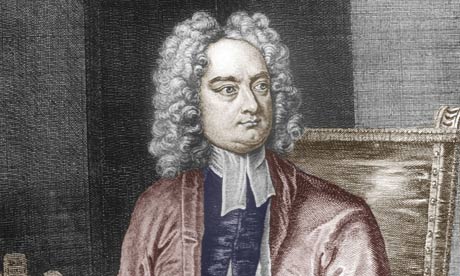
Jonathan Swift

For historians of science, Jonathan Swift’s book Gulliver’s Travels is well known both as a work of what we might call proto-science fiction and as a satire on the experimental philosophy that was being promoted by the Royal Society at the time of its publication – two years before the death of Isaac Newton.

A couple of weeks ago I went to a talk at the very same Society that Swift had mocked as wasting time on projects such as the extraction of sunbeams from cucumbers. It was given by Dr Greg Lynall, a Lecturer in English at the University of Liverpool. He is author of Swift and Science: The Satire, Politics, and Theology of Natural Knowledge, which looks well-worth a read from the review posted on the website of the British Society for Literature and Science.

Swift was a…

View original post 800 more words

Posted in Uncategorized | 2 Comments