
Guest Post by Sally Calder
Recently, a 15 year old boy from Quebec (Canada) made headlines by discovering an ancient Mayan city without leaving his computer. William Gadourey theorized that the Maya aligned their cities in accordance with the stars, worked out the positioning of such alignments during Mayan times, and realised that while his theory worked for most known Mayan cities, one major constellation remained unaccounted for. Gadourey turned to Google Earth to see what lay in the position aligned with this constellation – and struck Mayan gold. Google’s satellite images showed what Gadourey claims are the linear outlines of around thirty visible buildings and a pyramid, buried within the jungle. Impressive stuff, which has earned Gadourey praise from NASA, among other august institutions. Some, however, have been quick to pooh-pooh Gadourey’s work, claiming that one cannot possibly draw such grand conclusions from a simple Google Earth search. They shouldn’t be so sure. A surprising number of incredible discoveries have been made using Google Earth. Here are just a few…
The Badlands Guardian
Staying in Canada for a moment, someone idly scrolling over the clay hills of Alberta was startled to find what appeared to be a shockingly detailed – and gigantic – face in the rock. It’s a very modern face, casting a weary gaze into middle-distance, and evidently wearing headphones. The Badlands Guardian is clearly well acquainted with the technology of today – although s/he would be advised to invest in some cover for their enormous clay gadgets, as the ‘string’ which forms their headphones is a road, and their earbud an oil well. Not the ideal environment for listening to music! The ‘face’ itself is formed from valleys in the clay, and is entirely invisible from ground level. Still, the level of detail on the satellite image is truly astonishing!
2000 Archeological Sites In Saudi Arabia
Saudi Arabia is a nation steeped in very ancient history. However, the current regime’s attitude towards the country’s archeological wealth is, shall we say, complex. Archeology is generally discouraged – and, even if it were not, the vastness of the desert in the country’s Empty Quarter makes expeditions logistically tricky. Luckily, we have Google Earth. Google Earth has allowed an Australian professor who has never been near Saudi Arabia to identify around 2,000 potential sites of archeological interest, including intriguing ‘teardrop’ tombs. Whether being able to ‘discover’ them but not investigate them fully is better or worse than never knowing about them at all remains an unanswered question…
The Kamil Crater
The Kamil Crater is an enormous hole in the middle of Egypt. It was discovered in 2008 by a group of scientists perusing Google Earth. They immediately identified it as a meteor impact crater – and a young one at that. Further investigation proved that the crater was 147 feet wide and 52 feet deep. Space debris was collected from the crater, which indicated that the meteor was a lump of solid iron. The meteor hit at such speed (estimated to be around 3.5 km per second) that it splattered all over the desert, as is evidenced by the ‘ejecta rays’ surrounding it. Such ‘ejecta rays’ are seen in meteor scars upon moons and planets with thin to no atmosphere, but are unseen anywhere else on Earth. It’s thought that he meteor hit Egypt about 5,000 years ago (around the same time as the Pyramids were being built). Because of its youth and well-preserved status, the Kamil Crater is telling us an awful lot about meteor strikes and interstellar traffic!
The Mount Mabu Forest
Mount Mabu in Mozambique is home to the largest rainforest in Southern Africa. And nobody knew it was there until just over ten years ago. Given humanity’s track record with rainforests, this was probably a good thing. Fortunately for the secret rainforest, its ‘discoverers’ were a group of researchers from Kew Gardens, England, renowned for its conservation work. And they found it – you guessed it – using Google Earth. Kew have since launched a more conventional expedition to the ‘Google Rainforest’. They found it to be in reasonably good condition, with high levels of biodiversity and – excitingly – several new species unknown to science. Work us currently underway to protect and conserve this hidden gem.


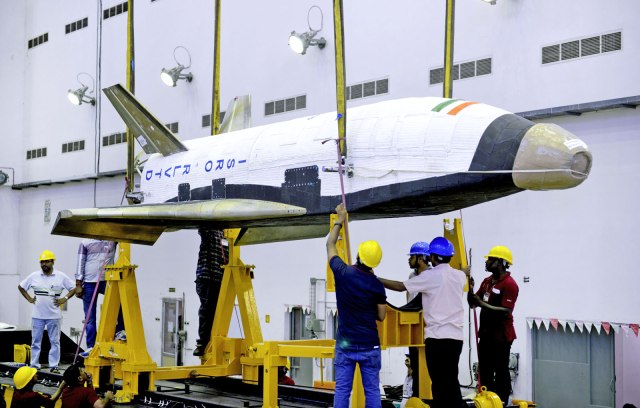 In another big leap India successfully launched RLV-TD, a prototype reusable space vehicle. The craft rose 43 miles into the air before gliding back down, making a safe landing in the Bay of Bengal. it was a technology demonstrator but with this India has stepped into another elite club. Though there was not much fanfare but certainly it is a big leap


