Everyone lives, works or plays in a watershed.
What is a Watershed
An area of land that drains water to the lowest point—a river, stream, lake, or ocean.
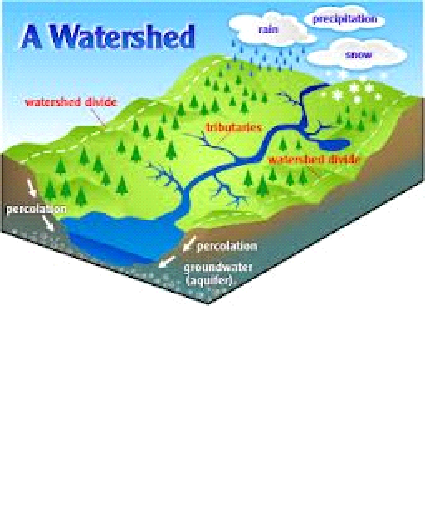
It is an area of land that catches rain and snow and drains or seeps into a marsh, stream, river, lake or groundwater. Homes, farms, cottages, forests, small towns, big cities and more can make up watersheds. Some cross municipal, provincial and even international boarders. They come in all shapes and sizes and can vary from millions of acres, like the land that drains into the Great lakes, to a few acres that drain into a pond.
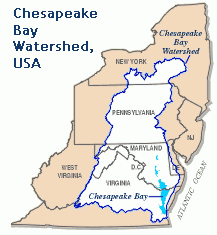
A watershed is the area of land where all of the water that falls in it and drains off of it goes to a common outlet. Watersheds can be as small as a footprint or large enough to encompass all the land that drains water into rivers that drain into Chesapeake Bay, where it enters the Atlantic Ocean.
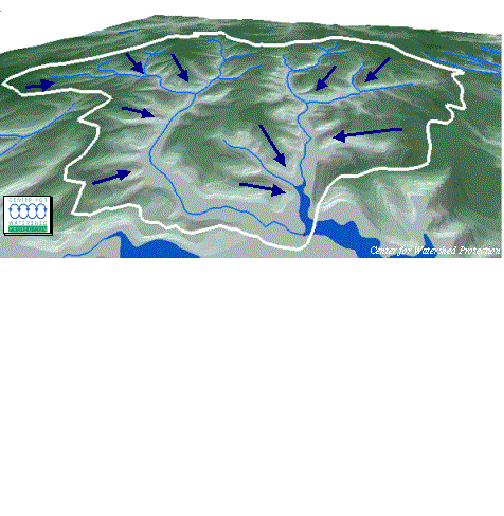
The area within the white line is the watershed that drains into the tributaries that will eventually flow in to larger river and then on to the ocean.
A watershed is a precipitation collector.Most of the precipitation that falls within the drainage area of a stream’s monitoring site collects in the stream and eventually flows by the monitoring site. Many factors determine how much of the streamflow will flow by the monitoring site.
Not all precipitation that falls in a watershed flows out
 To see a watershed as a plastic-covered area of land that collects precipitation is overly simplistic. There are many factors that determine how much water flows in a stream (these factors are universal in nature and not particular to a single stream):
- Precipitation: The greatest factor controlling streamflow, by far, is the amount of precipitation that falls in the watershed as rain or snow. However, not all precipitation that falls in a watershed flows out, and a stream will often continue to flow where there is no direct runoff from recent precipitation.
- Infiltration: When rain falls on dry ground, some of the water soaks in, or infiltrates the soil. Some water that infiltrates will remain in the shallow soil layer, where it will gradually move downhill, through the soil, and eventually enters the stream by seepage into the stream bank. Some of the water may infiltrate much deeper, recharging groundwater aquifers. Water may travel long distances or remain in storage for long periods before returning to the surface. The amount of water that will soak in over time depends on several characteristics of the watershed:
- Soil characteristics: In Georgia, clayey and rockey soils of the northern areas absorb less water at a slower rate than sandy soils, such as in Georgia’s Coastal Plain. Soils absorbing less water results in more runoff overland into streams.
- Soil saturation: Like a wet sponge, soil already saturated from previous rainfall can’t absorb much more … thus more rainfall will become surface runoff.
- Land cover: Some land covers have a great impact on infiltration and rainfall runoff. Impervious surfaces, such as parking lots, roads, and developments, act as a “fast lane” for rainfall – right into storm drains that drain directly into streams. Flooding becomes more prevalent as the area of impervious surfaces increase.
- Slope of the land: Water falling on steeply-sloped land runs off more quickly than water falling on flat land.
- Evaporation: Water from rainfall returns to the atmosphere largely through evaporation. The amount of evaporation depends on temperature, solar radiation, wind, atmospheric pressure, and other factors.
- Transpiration: The root systems of plants absorb water from the surrounding soil in various amounts. Most of this water moves through the plant and escapes into the atmosphere through the leaves. Transpiration is controlled by the same factors as evaporation, and by the characteristics and density of the vegetation. Vegetation slows runoff and allows water to seep into the ground.
- Storage: Reservoirs store water and increase the amount of water that evaporates and infiltrates. The storage and release of water in reservoirs can have a significant effect on the stream flow patterns of the river below the dam.
- Water use by people: Uses of a stream might range from a few homeowners and businesses pumping small amounts of water to irrigate their lawns to large amounts of water withdrawals for irrigation, industries, mining, and to supply populations with drinking water.
Source(s), Inspiration(s) and Link(s):
click here for animation
Read more about watersheds
USGS


 ‘Stonehenge, 2 May 1816’ by Francis Etheridge.