The Rising Costs of the Climate War

Iowa Climate Science Education's avatarIowa Climate Science Education

By Alan Moran

Rio Tinto’s [Paywall] announced closure of its aluminium smelter in New Zealand due to uncompetitive power prices is a reminder of the vulnerability of Australia’s four remaining smelters, all of which face sharply higher prices courtesy of government energy policies. With energy costs comprising about a third of their total costs, smelters are industry’s bellwethers of future energy competitiveness and all four of Australia’s are on national suicide watch.

As a result of subsidies to wind and solar, these expensive and unreliable energy sources have caused high customer costs, both directly and indirectly, while also diverting the nation’s investment resources into avenues that actually damage the economy.

Commonwealth and state subsidies to wind and solar energy are running at just under $7 billion a year. $4 billion of these are as a result of requirements imposed on consumers by the Commonwealth’s Renewable Energy Target, its similar provisions…

View original post 663 more words
Posted in earth | Leave a comment

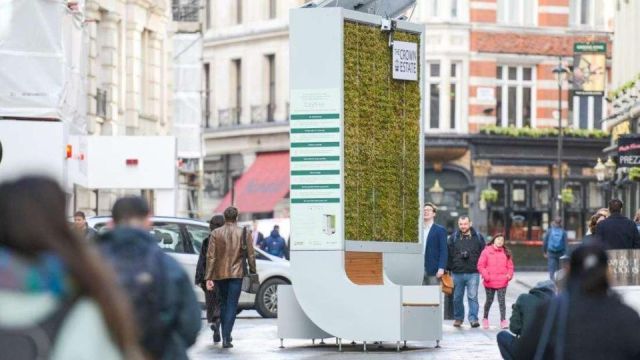
This City Bench Absorbs More Air Pollution Than A Forest

https3a2f2fblogs-images.forbes.com2ftrevornace2ffiles2f20182f032fbench-pollution

London is the latest city to gain a city bench with the ability to absorb as much pollution as a small forest. The vertical garden, which doubles as a bench, is Green City Solutions’ CityTree. Using a vertical installation of moss, the bench can absorb as much pollution as 275 trees in 1 percent of the space.

The World Health Organization estimates that 7 million premature deaths occur each year from air pollution, making it one of the largest environmental health risks in the world.

The bench has already been installed in cities across Europe and Asia, including Berlin, Oslo, Paris, Amsterdam, Brussels, Drammen, Newcastle, and Hong Kong. The latest city to gain a CityTree is London near Piccadilly Circus.

Source: Forbes

Posted in earth, Glimpses of Our Cities, Green spaces | Leave a comment

Artificial intelligence can tackle climate change

Climate change is the biggest challenge facing the planet. It will need every solution possible, including technology like artificial intelligence (AI).

Seeing a chance to help the cause, some of the biggest names in AI and machine learning—a discipline within the field—recently published a paper called “Tackling Climate Change with Machine Learning.” The paper, which was discussed at a workshop during a major AI conference in June, was a “call to arms” to bring researchers together, said David Rolnick, a University of Pennsylvania postdoctoral fellow and one of the authors.

“It’s surprising how many problems machine learning can meaningfully contribute to,” says Rolnick, who also helped organize the June workshop.

The paper offers up 13 areas where machine learning can be deployed, including energy production, CO2 removal, education, solar geoengineering, and finance. Within these fields, the possibilities include more energy-efficient buildings, creating new low-carbon materials, better monitoring of deforestation, and greener transportation. However, despite the potential, Rolnick points out that this is early days and AI can’t solve everything.

read more here

Posted in AI, earth, inventions, opinions | Leave a comment

Covid-19, Geography and Urban Ecology: practitioner experiences

RGS-IBG Managing Editor: Academic Publications's avatarGeography Directions

By Ian Douglas, University of Manchester, UK

As with other disasters, be they due to human folly or geophysical forces, Covid-19 is impinging upon all aspects of geography and human life. We are advised thatmany of the lessons from this pandemic are applicable to other global crisessuch as global heating and the extinction crisis. It is also illuminating thehuge, persistent, social and economic inequalities across the worlds and within nation statesFear ofaggravated food security and hunger crisesconcern under-funded bodies such as the World Health Organisation (WHO) and the Food and Agricultural Organisation of the United Nations (FAO).

Fundamental geographical questions of spatial scale loom large when global and national responses to the pandemic are compared. Have states with effectively devolved regional and local governments delivered better responses than those with highly centralised administrations? How have local circumstances affected the spatial pattern and numbers of…

View original post 1,222 more words

Posted in earth | Leave a comment