Sixty years ago , the United States dropped atomic bombs on Hiroshima and Nagasaki, the Soviet Union declared war on Japan, and the Japanese government surrendered to the United States and its allies. The nuclear age had truly begun with the first military use of atomic weapons. With the material that follows, the National Security Archive publishes the most comprehensive on-line collection to date of declassified U.S. government documents on the atomic bomb and the end of the war in the Pacific. Besides material from the files of the Manhattan Project, this collection includes formerly “Top Secret Ultra” summaries and translations of Japanese diplomatic cable traffic intercepted under the “Magic” program. Moreover, the collection includes for the first time translations from Japanese sources of high level meetings and discussions in Tokyo, including the conferences when Emperor Hirohito authorized the final decision to surrender.
ver since the atomic bombs were exploded over Japanese cities, historians, social scientists, journalists, World War II veterans, and ordinary citizens have engaged in intense controversy about the events of August 1945. John Hersey’s Hiroshima, first published in the New Yorker in 1946 made some unsettled readers question the bombings while church groups and a few commentators, most prominently Norman Cousins, explicitly criticized them. Former Secretary of War Henry Stimson found the criticisms troubling and published an influential justification for the attacks in Harper’s.During the 1960s the availability of primary sources made historical research and writing possible and the debate became more vigorous. Historians Herbert Feis and Gar Alperovitz raised searching questions about the first use of nuclear weapons and their broader political and diplomatic implications. The controversy, especially the arguments made by Alperovitz and others about “atomic diplomacy” quickly became caught up in heated debates about Cold War “revisionism.” The controversy simmered over the years with major contributions by Martin Sherwin and Barton J. Bernstein but it became explosive during the mid-1990s when curators at the National Air and Space Museum met the wrath of the Air Force Association over a proposed historical exhibit on the Enola Gay.The NASM exhibit was drastically scaled down but historians and journalists continued to engage in the debate. Alperovitz, Bernstein, and Sherwin made new contributions to the debate as did historians, social scientists, and journalists such as Richard B. Frank, Herbert Bix, Sadao Asada, Kai Bird, Robert James Maddox, Robert P. Newman, Robert S. Norris, Tsuyoshi Hagesawa, and J. Samuel Walker.The controversy has revolved around the following, among other, questions:
->Were atomic strikes necessary primarily to avert an invasion of Japan in November 1945?
->Did Truman authorize the use of atomic bombs for diplomatic-political reasons– to intimidate the Soviets–or was his major goal to force Japan to surrender and bring the war to an early end?
->If ending the war quickly was the most important motivation of Truman and his advisers to what extent did they see an “atomic diplomacy” capability as a “bonus”?
->To what extent did subsequent justification for the atomic bomb exaggerate or misuse wartime estimates for U.S. casualties stemming from an invasion of Japan?
->Were there alternatives to the use of the weapons? If there were, what were they and how plausible are they in retrospect? Why were alternatives not pursued?
->How did the U.S. government plan to use the bombs? What concepts did war planners use to select targets? To what extent were senior officials interested in looking at alternatives to urban targets? How familiar was President Truman with the concepts that led target planners to choose major cities as targets?
->Did President Truman make a decision, in a robust sense, to use the bomb or did he inherit a decision that had already been made?
->Were the Japanese ready to surrender before the bombs were dropped? To what extent had Emperor Hirohito prolonged the war unnecessarily by not seizing opportunities for surrender?
->If the United States had been more flexible about the demand for “unconditional surrender” by guaranteeing a constitutional monarchy would Japan have surrendered earlier than it did?
->How greatly did the atomic bombings affect the Japanese decision to surrender?
->Was the bombing of Nagasaki unnecessary? To the extent that the atomic bombing was critically important to the Japanese decision to surrender would it have been enough to destroy one city?
->Would the Soviet declaration of war have been enough to compel Tokyo to admit defeat?
->Was the dropping of the atomic bombs morally justifiable?
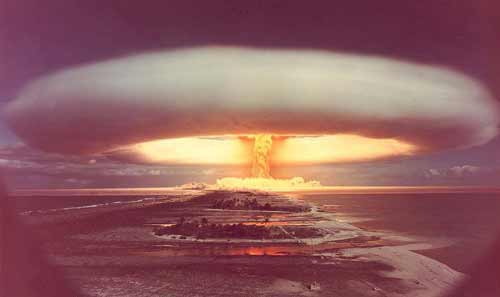
Here are some glimpses of power of atomic arsenels.


Links:
http://www.gwu.edu/~nsarchiv/NSAEBB/NSAEBB162/index.htm
http://en.wikipedia.org/wiki/Nuclear_weapon
Atomic bombings of Hiroshima and Nagasaki
History of the Atomic Bomb and The Manhattan Project

 India’s Abhinav Bindra gave India a very good reason to smile and feel proud as he won gold in the 10m Air Rifle event.
 material to many millions of degrees and release as much energy as a billion megatons of TNT. They occur near sunspots, usually along the dividing line (neutral line) between areas of oppositely directed magnetic fields.