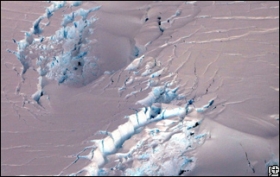
Ancient Antarctic Mountains Found Under Miles of Ice

Millions of years ago, rivers ran in Antarctica through craggy mountain valleys that were strangely similar to the modern European Alps, Chinese and British scientists reported on Wednesday.

In a study published by the British journal Nature, the scientists described a vast terrain that had been hidden beneath ice up to two miles thick for eons, until new imaging technology recently uncovered them.

read on

Posted in Ecosystem | Leave a comment

Study finds forest conservation in Indonesia could be as profitable as palm oil plantations

Selling credits for the billions of tons of carbon that are locked in Indonesia’s tropical rain forests could be as profitable as converting these areas into palm oil plantations, a study   found.The study, in the current issue of the peer-reviewed journal Conservation Letters, also found that conserving the 3.3 million hectares (8.2 million acres) that are slated to become plantations on Kalimantan, on the island of Borneo, would boost the region’s biodiversity. The 800 proposed plantations that were studied contain 40 of the region’s 46 threatened mammals including orangutans and pygmy elephants, the study found.

The study concludstudyed that conserving forests would be more profitable than clearing them for palm oil if the credits could be sold for $10 to $33 per ton. Currently, the rate per ton is around $20, the study said.

source

picture source

Posted in Uncategorized | Leave a comment

Mysterious night-shining clouds may peak this year

Sky watchers in the northern hemisphere have snapped the first images of this year’s noctilucent clouds — silvery blue structures that are the highest clouds to form in Earth’s atmosphere. This season’s crop of clouds could be the biggest in years due to the lull in the sun’s activity.

“Noctilucent”, or night-shining, clouds float dozens of kilometres higher than other clouds, at an altitude of about 80 km. Because of their height, they can be seen glowing before sunrise or after sunset as the sun illuminates them from below the horizon.

The clouds were first seen above polar regions in 1885, suggesting they may have been caused by the eruption of Krakatoa two years before. But in recent years the clouds have spread to latitudes as low as 40°, while also growing in number and getting brighter. The reason for the clouds’ spread is unclear, but some suspect it could be due to an increase in greenhouse gases. That’s because the gases actually cause Earth’s upper atmosphere to cool, and the clouds need cold temperatures to form.

Although the average number of noctilucent clouds has been increasing in recent decades, their abundance also seems to rise and fall with the sun’s 11-year cycle of activity. The clouds thrive when the sun is quiet and spews less ultraviolet radiation, which can destroy water needed to form the clouds and can keep temperatures too high for ice particles to form.

source

Posted in Uncategorized | Leave a comment

NASA Scientists Find Evidence For Liquid Water On A Frozen Early Mars

Evidence suggests flowing water formed the rivers and gullies on the Mars surface, even though surface temperatures were below freezing. Dissolved minerals in liquid water may be the reason. (Credit: NASA and The Hubble Heritage Team (STScI/AURA))

NASA scientists modeled freezing conditions on Mars to test whether liquid water could have been present to form the surface features of the Martian landscape.

Researchers report that fluids loaded with dissolved minerals containing elements such as silicon, iron, magnesium, potassium and aluminum, can remain in a liquid state at temperatures well below freezing. The results of this research appear in the May 21 issue of Nature magazine entitled “Stability Against Freezing of Aqueous Solutions on Early Mars.”

dig deeper

Posted in inventions | Leave a comment