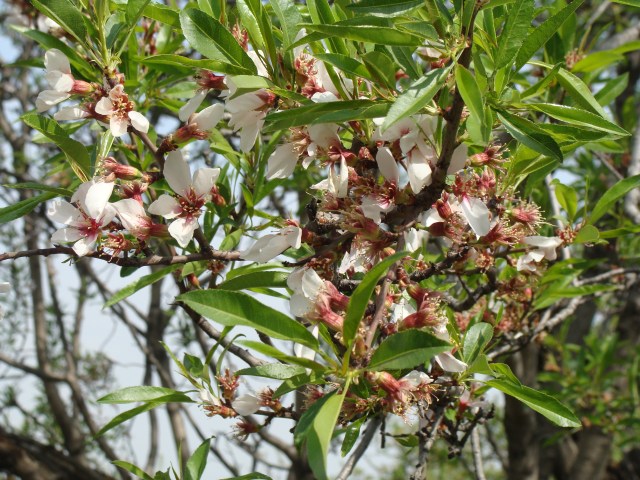
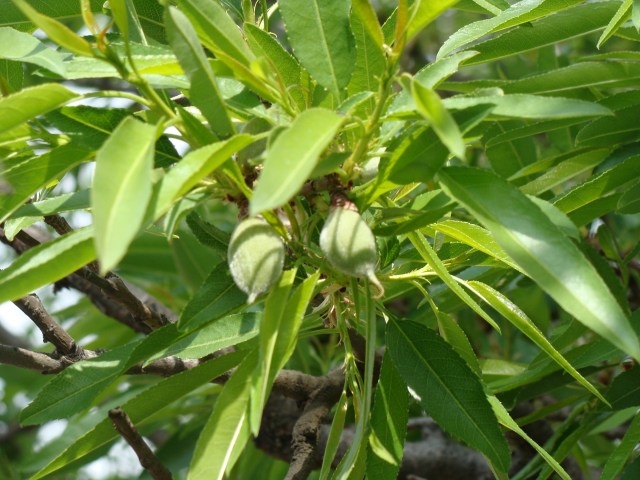
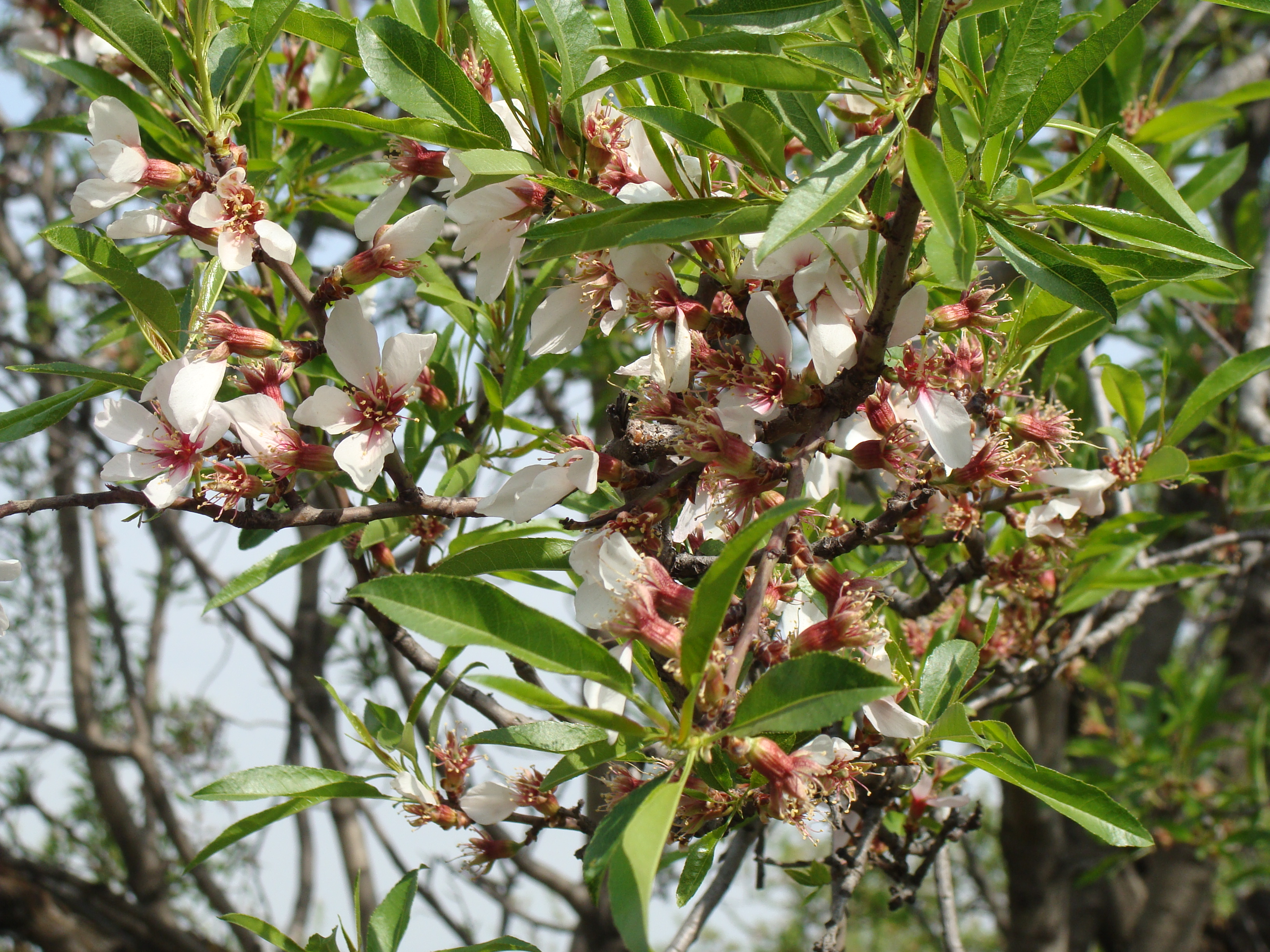
Despite all odds Almond Flowers are blooming in Valley. Raw Almonds are also there. We were on a drive and these trees captured our imagination. We could not resist and captured them. The raw Almonds were looking like Green Pearls.
The Almond (Prunus dulcis, syn. Prunus amygdalus Batsch., Amygdalus communis L., Amygdalus dulcis Mill.) is a species of tree native to the Middle East. Almond is also the name of the edible and widely cultivated seed of this tree. Within the genus Prunus, it is classified with Peach in the subgenus Amygdalus, distinguished from the other subgenera by the corrugated shell (endocarp) surrounding the seed.
The fruit of the almond is not a true nut, but a drupe, which consists of an outer hull and a hard shell with the seed (nut) inside. Shelling almonds refers to removing the shell to reveal the seed. Almonds are commonly sold shelled, i.e. after the shells are removed, or unshelled, i.e. with the shells still attached. Blanched almonds are shelled almonds that have been treated with hot water to soften the seedcoat, which is then removed to reveal the white embryo.
Etymology
The word “almond” comes from Old French almande or alemande, Late Latin amandola, derived through a form amingdola from the Greek αμυγδαλη (cf amygdala), an almond. The al- for a- may be due to a confusion with the Arabic article al, the word having first dropped the a- as in the Italian form mandorla; the British pronunciation ah-mond and the modern Catalan ametlla and modern French amande show a form of the word closer to the original.
The adjective “amygdaloid” (literally “like an almond”) is used for things which are roughly almond-shaped, particularly a shape which is partway between a rectangle and an ellipse.
Almond is called لوز lawz in Arabic and baadaam in Persian, Hindi, Punjabi, Tamil, Bengali, Telugu, Malayalam, Kannada, Marathi, Gujarati, Turkish, Urdu and Kashmiri. In German almond is called “Mandel”, as well as “Almond”. In Hebrew almond is called שקד shaqed, which has its roots in an ancient Semitic term, as seen in the Akkadian šiqdu and Ugaritic thaqid, as well as in old Ethiopic terms.
Consumption of Almond lowers cholesterol levels, reduces the risk of lifestyle diseases and gives overall wellness.
In Italy wedding hosts often gave sugar-coated almonds wrapped in shear fabric to their guests symbolising good health, fertility, romance, fortune and happiness.
Throughout history, almonds have maintained religious, ethnic and social significance. Almonds are appreciated as a staple in the Indian culture not only for their crunch, but also for their nutritional qualities and their health sustaining properties.
A seed from the stone fruit family, almonds are a rich source of nutrients, most notably Vitamin E and protein. A research conducted over the past decade has shown strong links of almond consumption with lowering cholesterol levels, reducing the risk of lifestyle diseases, and overall wellness. Research into nuts has been so extensive that a qualified health claims for certain nuts such as almonds; ability to reduce the risk of heart disease has been approved by the Food and Drug administration in the US.
Almonds help in fighting diabetes and heart Diseases: The presence of powerful nutrients like proteins, dietary fibre, mono unsaturated fatty acids (MUFA) and Vitamin E make almond a rich diet source for combating degenerative diseases such as diabetes and heart diseases.
Almonds are the best source of alpha-tocopherol form of Vitamin-E: Almonds are among the best whole food sources and the bet nut source of alphatocepherol form of Vitamin E. The U.S. National Academy of Science (NAS) recommends consuming 15 milligrams of alpha tocopherol Vitamin E per day. Alpha-tocopherol is one of the form of Vitamin E that is most effeciciently used by the human body.
Almonds are a great cholestrol lowering food: Nearly 70 percent of the fat in almonds is mono saturated, a suggested substitute to saturated fats, to reduce the cholesterol levels. Research also shows that almond and almond oil have similar cholesterol-lowering effects. Infact eating almonds consistently lowers total and LDL cholesterol respectively by four and five percent. This cholesterol lowering effect is similar to heart healthy foods such as oats and soy. Almonds can be consumed in various ways. Their delicious tasty flavour relieves the monotony of the regular diets for diabetic and heart patients.
External Sources:
Wikipedia
Health Tips and Techniques




 Rashid's Blog: A Place for Inquisitive Souls