What is resilience?

Jeremy's avatarOpen Geography

Interesting alternatives if not contradictions in understanding “resilience” in recent publications.

Stephanie Wakefield & Bruce Braun understand resilience as a Foucauldian dispositif (apparatus):

we understand resilience as a mode of governing the ‘ecological’ city.

In Resilient Life, a new book by Brad Evans and Julian Reid, they also think of it as a mode of governing:

‘resilience’ … is becoming a key term of art for governing planetary life in the 21st Century…

But the book is then blurbed as follows:

Resilience, they argue, is a neo-liberal deceit that works by disempowering endangered populations of autonomous agency.

My interest here is not so much whether this is an accurate summation of their book (which is not yet out) but that the discourse of resilience is framed as disempowering (the word used is “nihilistic”).

I wrote about this last year here, in the context of Neocleous’ piece in

View original post 459 more words

Posted in Uncategorized | Leave a comment

Supercomputer says no: gridding the Earth in next-generation weather and climate models

Andrew McRae's avatarClimateSnack

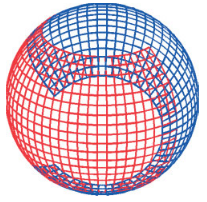
The "Yin-Yang", or "tennis ball" grid, which may be used in future climate simulations The “Yin-Yang” grid, or “tennis ball” grid, is under consideration for use in future climate models.

Making a timely weather forecast, or running a high-resolution global climate model, requires the use of a massive supercomputer. Simulations that would take months to run on a normal computer take just hours on a supercomputer. However, supercomputers are far from magic. Programs have to be designed in very specific ways in order to make full use of a supercomputer’s capabilities. It is well-known that current weather and climate models will be incapable of making good use of future supercomputers. Next-generation models will need some drastic changes in order to make better use of the supercomputers that they will run on. This Snack explains what the problem with current models is and explains why it will be necessary to change the underlying grid that the model uses.

View original post 1,166 more words

Posted in Uncategorized | Leave a comment

An Ice Age for Indian scholarship

apoorvanand's avatarKAFILA - COLLECTIVE EXPLORATIONS SINCE 2006

These are lonely times for scholarship in India.Shiksha Bachao Andolan Samiti( SBAS) has claimed yet another scalp in the form of the withdrawal of Wendy Doniger’s book ‘The Hindus:An alternative history’ by its publishers Penguin,India. The author, while ‘angry and disappointed’ by this decision has said that she can understand the plight of her publishers who were fighting a criminal case and not a civil suit. It had serious implications for their physical safety. Fellow scholars and academics are upset and angry that the publishers have caved in.

The question we need to ask ourselves, however is about our own role in this whole affair. There were not too many voices of protest  when the same SBAS forced the Calicut University to remove a poem by an unknown poet from an English language textbook alleging that the poet was a ‘terrorist’. Its editors felt compelled to apologize…

View original post 786 more words

Posted in Uncategorized | Leave a comment

Rethinking Global Food Security

canwefeedtheworld's avatarOne Billion Hungry: Can We Feed the World?

weforum-logo.db90160d8175c5a08cdf6c621e387d18 At the World Economic Forum , held in Davos in January 2014, experts on food security, Ellen Kullman, Chair of the Board and Chief Executive Officer of DuPont; Michel M. Liès, Group Chief Executive Officer, Swiss Re; Shenggen Fan, Director-General, International Food Policy Research Institute (IFPRI); Ajay Vir Jakhar, Chairman, Bharat Krishak Samaj ( Farmers’ Forum India ) and Akinwumi Ayodeji Adesina, Minister of Agriculture and Rural Development of Nigeria came together to discuss how we can produce enough healthy food for everyone.

Moderator, Rajiv J. Shah, Administrator, US Agency for International Development (USAID), began the discussion by stating that the global population is at 7 billion, 850 million of which don’t get enough to eat. By 2050 the population will rise to over 9 billion and we need to find ways of producing sufficient food for this enlarged population whilst also coping with environmental changes. Every economy that has…

View original post 1,008 more words

Posted in Uncategorized | Leave a comment