Fifth Ocean?

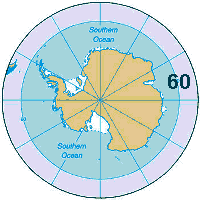
In 2000, the International Hydrographic Organization cleared the discovery of  the fifth and newest world ocean – the Southern Ocean – from the southern portions of the Atlantic Ocean, Indian Ocean, and Pacific Ocean. This new  Ocean completely surrounds Antarctica.

The new ocean extends from the coast of Antarctica north to 60 degrees south latitude. The Southern Ocean is now the fourth largest of the world’s five oceans (after the Pacific Ocean, Atlantic Ocean, and Indian Ocean, but larger than the Arctic Ocean).

For some time, those in geographic circles have debated whether there are four or five oceans on earth.

Some consider the Arctic, Atlantic, Indian, and Pacific to be the world’s four oceans. Now, those that side with the number five can add the fifth new ocean and call it the Southern Ocean or the Antarctic Ocean, thanks to the International Hydrographic Organization (IHO). The IHO has attempted to settle that debate through a year 2000 publication by declaring, naming, and demarcating the Southern Ocean.

The IHO published the third edition of Limits of Oceans and Seas (S-23), the global authority on the names and locations of seas and oceans, in 2000. The third edition in 2000 established the existence of the Southern Ocean as the fifth world ocean.

There are 68 member countries of the IHO and membership is limited to non-landlocked countries. Twenty-eight countries responded to the IHO’s request for recommendations on what to do about the Southern Ocean. All responding members except Argentina agreed that the ocean surrounding Antarctica should be created and given a single name. Eighteen of the twenty-eight responding countries preferred calling the ocean the Southern Ocean over the alternative name Antarctic Ocean so the former is the one that was selected.

The Southern Ocean consists of the ocean surrounding Antarctica across all degrees of longitude and up to a northern boundary at 60° South latitude (which is also the limit of the United Nations’ Antarctic Treaty.) Half of the responding countries supported 60° South while only seven preferred 50° South as the ocean’s northern limit. The IHO decided that, even with a mere 50% support for 60°, since 60°S does not run through land (50°S does pass through South America) that 60°S should be the northern limit of the newly demarcated ocean.

Why the need for a new Southern Ocean? According to Commodore John Leech of the IHO, “A great deal of oceanographic research in recent years has been concerned with ocean circulations, first because of El Nino, and then because of a wider interest in global warming…(this research has) identified that one of the main drivers of ocean systems is the ‘Southern Circulation,’ which sets the Southern Ocean apart as a separate eco-system. As a result the term Southern Ocean has been used to define that huge body of water which lies south of the northern limit. Thinking of this body of water as various parts of the Atlantic, Indian and Pacific Oceans makes no scientific sense. New national boundaries arise for geographical, cultural or ethnic reasons. Why not a new ocean, if there is sufficient cause?”

At approximately 20.3 million square kilometers (7.8 million square miles) and about twice the size of the U.S.A., the new ocean is the world’s fourth largest (following the Pacific, Atlantic, and Indian but larger than the Arctic Ocean.) The Southern Ocean’s lowest point is 7,235 meters (23,737 feet) below sea level in the South Sandwich Trench.

The sea temperature of the Southern Ocean varies from -2°C to 10°C (28°F to 50°F). It’s home to the world’s largest ocean current, the Antarctic Circumpolar Current that moves east and transports 100 times the flow of all the world’s rivers.

Despite the demarcation of this new ocean, it’s likely that the debate over the number of oceans will continue .

Links and Sources:
source

National Geographic

wikipedia

A New Ocean is Born:
The fifth “Southern Ocean

The World Factbook. 2008


Posted in oceans | Leave a comment

New Hubble Maps of Pluto Show Surface Changes

NASA has released the most detailed set of images ever taken of the distant dwarf planet Pluto. The images taken by NASA’s Hubble Space Telescope show an icy and dark molasses-colored, mottled world that is undergoing seasonal changes in its surface color and brightness.

here

Posted in Solar System, Space | 1 Comment

Breccia

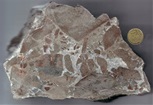
breccia 1Breccia is a rock made of smaller rocks, like conglomerate. But breccia contains sharp, broken clasts while conglomerate has smooth, round clasts. Breccia (pronounced /ˈbrɛtʃiə, ˈbrɛʃiə/, Italian: breach) is a rock composed of angular fragments of minerals or rocks in a matrix (cementing material), that may be similar or different in composition to the fragments. The word is a loan from Italian, and in that language indicates both loose gravel and stone made by cemented gravel. A breccia may have a variety of different origins, as indicated by the named types including sedimentary breccia, tectonic breccia, igneous breccia, impact breccia and hydrothermal breccia.

Breccia is usually listed under sedimentary rocks, but igneous and metamorphic rocks may become shattered, too. It is safest to think of brecciation as a process rather than breccia as a rock type. As a sedimentary rock, breccia is a variety of conglomerate.

There are many different ways to make breccia, and usually geologists add a word to signify the kind of breccia they’re talking about. A sedimentary breccia arises from things like talus or landslide debris. A volcanic or igneous breccia forms during eruptive activities. A collapse breccia forms when rocks are partly dissolved, such as limestone or marble. One created by tectonic activity is a fault breccia. And a new member of the family, first described from the Moon, is impact breccia.

Types

Sedimentary

Sedimentary breccias are a type of clastic sedimentary rock which are composed of angular to subangular, randomly oriented clasts of other sedimentary rocks. They are formed by either submarine debris flows, avalanches, mud flow or mass flow in an aqueous medium. Technically, turbidites are a form of debris flow deposit and are a fine-grained peripheral deposit to a sedimentary breccia flow.

The other derivation of sedimentary breccia is as angular, poorly sorted, immature fragments of rocks in a finer grained groundmass which are produced by mass wasting. These are, in essence, lithified colluvium. Thick sequences of sedimentary (colluvial) breccias are generally formed next to fault scarps in grabens.

In the field, it may at times be difficult to distinguish between a debris flow sedimentary breccia and a colluvial breccia, especially if one is working entirely from drilling information. Sedimentary breccias are an integral host rock for many SEDEX ore deposits.
Collapse

Collapse breccias form where there has been a collapse of rock, typically in a karst landscape. Collapse breccias form blankets in highly weathered regolith due to the removal of rock components by dissolution.

Tectonic

Tectonic breccias form where two tectonic plates create a crumbling of the interface, by their relative movements.

Fault

Fault breccias result from the grinding action of two fault blocks as they slide past each other. Subsequent cementation of these broken fragments may occur by means of mineral matter introduced by groundwater.

Igneous

Igneous clastic rocks can be divided into two classes.
Broken, fragmental rocks associated with volcanic eruptions, both of lava and pyroclastic type
Broken, fragmental rocks produced by intrusive processes, usually associated with plutons or porphyry stocks
Volcanic

Volcanic pyroclastic rocks are formed by explosive eruption of lava and any rocks which are entrained within the eruptive column. This may include rocks plucked off the wall of the magma conduit, or physically picked up by the ensuing pyroclastic surge. Lavas, especially rhyolite and dacite flows, tend to form clastic volcanic rocks by a process known as autobrecciation. This occurs when the thick, nearly solid lava breaks up into blocks and these blocks are then reincorporated into the lava flow again and mixed in with the remaining liquid magma. The resulting breccia is uniform in rock type and chemical composition.

Lavas may also pick up rock fragments, especially if flowing over unconsolidated rubble on the flanks of a volcano, and these form volcanic breccias, also called pillow breccias.

The volcanic breccia environment is transitional into the plutonic breccia environment in the volcanic conduits of explosive volcanoes, where lava tends to solidify and may be repeatedly shattered by ensuing eruptions. This is typical of volcanic caldera settings.

Intrusive

Clastic rocks are also commonly found in shallow subvolcanic intrusions such as porphyry stocks, granites and kimberlite pipes, where they are transitional with volcanic breccias.

Intrusive rocks can become brecciated in appearance by multiple stages of intrusion, especially if fresh magma is intruded into partly consolidated or solidified magma. This may be seen in many granite intrusions where later aplite veins form a late-stage stockwork through earlier phases of the granite mass. When particularly intense, the rock may appear as a chaotic breccia.

Clastic rocks in mafic and ultramafic intrusions are known and form via several processes;consumption and melt-mingling with wall rocks, where the felsic wall rocks are softened and gradually invaded by the hotter ultramafic intrusion (termed taxitic texture by Russian geologists)
Accumulation of rocks which fall through the magma chamber from the roof, forming chaotic remnants
Autobrecciation of partly consolidated cumulate by fresh magma injections or by violent disturbances within the magma chamber (e.g. postulated earthquakes)
Accumulation of xenoliths within a feeder conduit or vent conduit

Impact

Impact breccias are thought to be diagnostic of an impact event such as an asteroid or comet striking the Earth, and are usually found at impact craters. Impact breccia, a type of impactite, forms during the process of impact cratering when large meteorites or comets impact with the Earth or other rocky planets or asteroids. Breccia of this type may be present on or beneath the floor of the crater, in the rim, or in the ejecta expelled beyond the crater. Impact breccia may be identified by its occurrence in or around a known impact crater, and/or an association with other products of impact cratering such as shatter cones, impact glass, shocked minerals, and chemical and isotopic evidence of contamination with extraterrestrial material (e.g. iridium and osmium anomalies).

Hydrothermal

Hydrothermal breccia, Cloghleagh Iron Mine, near Blessington in Ireland, composed mainly of quartz and manganese oxides, the result of seismic activity about 12 million years ago.

Hydrothermal breccias usually form at shallow crustal levels (

Sources:

Wikipedia

About.com

More Links:

read more

Posted in rocks | Leave a comment

India is on the road of anti-satellite capabilities: DRDO

India is making the “building blocks” of the technology to develop anti-satellite capabilities as part of its space security measures according to DRDO chief V K Saraswat .He was responding to queries on India’s plans to develop capabilities to destroy satellites in space while speaking on the sidelines of a function to sign MoUs between DRDO laboratories and private industries to commercialise technologies developed by the defence research organisation.Asked about the developments in the indigenous Ballistic Missile Defence programme, he said, “the (BMD) test is going to be conducted in February.” DRDO is working on the BMD programme, under which it is developing a system to destroy incoming enemy ballistic missiles both in space and in earth’s atmosphere.

read it here

Posted in India, News, Satellites, Space | Leave a comment